Full-Cycle, Co-Development, or Dedicated Developers? How to Choose the Right Game Development Engagement Model
Full-cycle, co-development, or dedicated developers? How the three game development engagement models actually work, who owns what, what each really costs, and an honest look at when each one is a mistake.
Most teams that get burned by outsourcing didn't hire a bad studio. They hired the right studio under the wrong engagement model, a founder who needed full production bought hourly developers and became an accidental producer, or a studio mid-crunch bought a full-cycle contract and spent months fighting over creative control.
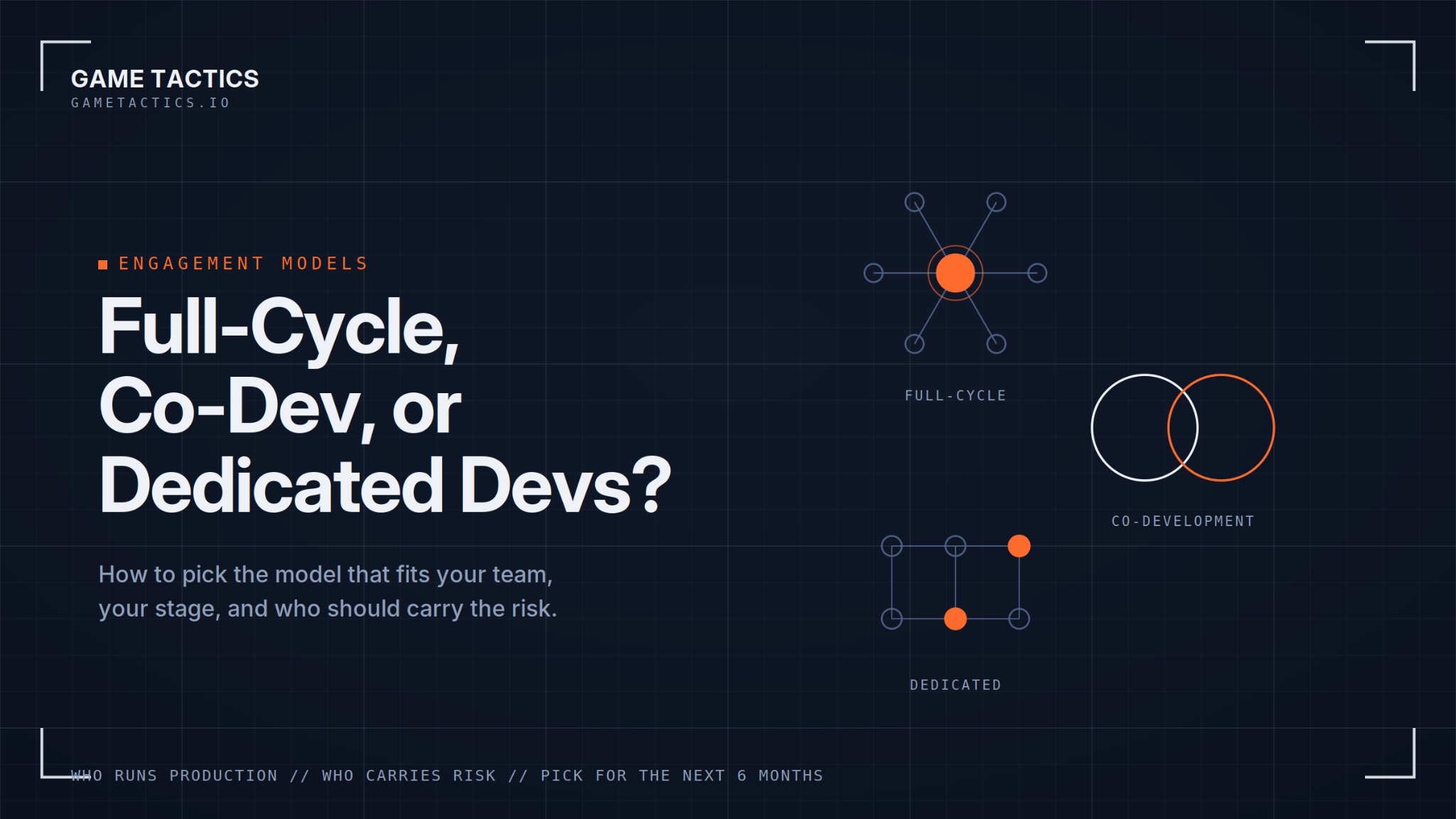
The model you choose determines who runs production, who carries risk, and what happens when something goes wrong. Here's how the three standard models actually work, and an honest look at when each one is a mistake.
What you'll learn
- How full-cycle, co-development, and dedicated developer models differ in practice
- Who owns what in each model (decisions, risk, pipeline)
- The real cost structure of each, not just the hourly rate
- A decision framework based on your team, stage, and budget
- Red flags that a studio is selling you the wrong model
The three models at a glance
| Full-cycle | Co-development | Dedicated developers | |
|---|---|---|---|
| Who runs production | The studio | Shared, you lead, studio executes in your pipeline | You |
| Best for | Founders, brands, funded teams with no dev team | Studios mid-production needing firepower | Capacity gaps on live titles |
| Pricing | Fixed price, milestone-based | Sprint-based or monthly | Hourly or monthly retainer |
| Your management overhead | Minimal | Moderate | High |
| Risk carrier | Mostly the studio | Shared | Mostly you |
| Speed to start | ~1 week after scoping | First reviewed PR in week one | Days |
Model 1: Full-cycle development
"We run the production. You own the vision." Full-cycle means one contract covers everything from concept to storefront: game design, art, code, QA, ASO, and store submission. You approve milestones and creative direction; the studio handles everything between.
When it's right: you don't have (or don't want) an internal dev team. First-time founders, brands entering gaming, and funded teams that want to stay focused on publishing and marketing all fit here. It's also the only model where a fixed price is genuinely possible, because the studio controls enough of the process to commit to one.
When it's wrong: you already have engineers and strong opinions about architecture. Handing a full-cycle contract to an external studio while your internal team watches creates the worst of both worlds, duplicated decisions and blurry accountability.
What to demand: fixed scope, milestones, and price agreed before code is written; playable builds on a regular cadence (we hand over a build you can tap every 48 hours, progress you can play, not status reports); and full IP assignment with repos in your name.
Model 2: Co-development
"We extend your team, without disrupting it." Co-development means the external team works inside your repo, your sprints, your standups, and your code standards. It's not a vendor relationship; it's additional senior capacity that plugs into an existing production.
When it's right: you're mid-production and the roadmap outgrew the team. A feature is slipping, a platform port is looming, or you need a specialist (multiplayer, performance, a specific SDK) you don't want to hire full-time. Co-dev keeps your team in charge of the vision while removing the bottleneck.
When it's wrong: you don't actually have a pipeline to plug into. If there's no repo, no producer, and no sprint cadence, co-development just becomes unmanaged freelancing with a nicer name. In that case you want full-cycle.
What to demand: a first reviewed pull request in week one, not after a "ramp-up month." How a team handles your code review process in the first two weeks tells you everything about the next six months. Also insist on named engineers, not a rotating bench.
Model 3: Dedicated developers
"Senior devs, assigned by name." The staffing model: you hire specific vetted engineers hourly or on a monthly retainer, and you direct their work day-to-day. Fastest to start, most flexible to scale up or down.
When it's right: capacity gaps on live titles. Your game is shipped, revenue is flowing, and you need reliable senior hands for LiveOps content, SDK updates, and feature work, without a three-month hiring cycle. It's also the right model when your producers are strong and simply need more execution bandwidth.
When it's wrong: you're using it to avoid scoping. If you can't write tickets and review work weekly, hourly developers will faithfully build the wrong thing at a fixed hourly rate. The model transfers nearly all production risk to you, that's the trade for its flexibility.
What to demand: engineers with shipped titles you can find on the actual stores, assigned by name in the contract, onboarded within days. If a studio won't tell you who you're getting, you're buying a bench, not a developer.
The decision framework
Answer three questions.
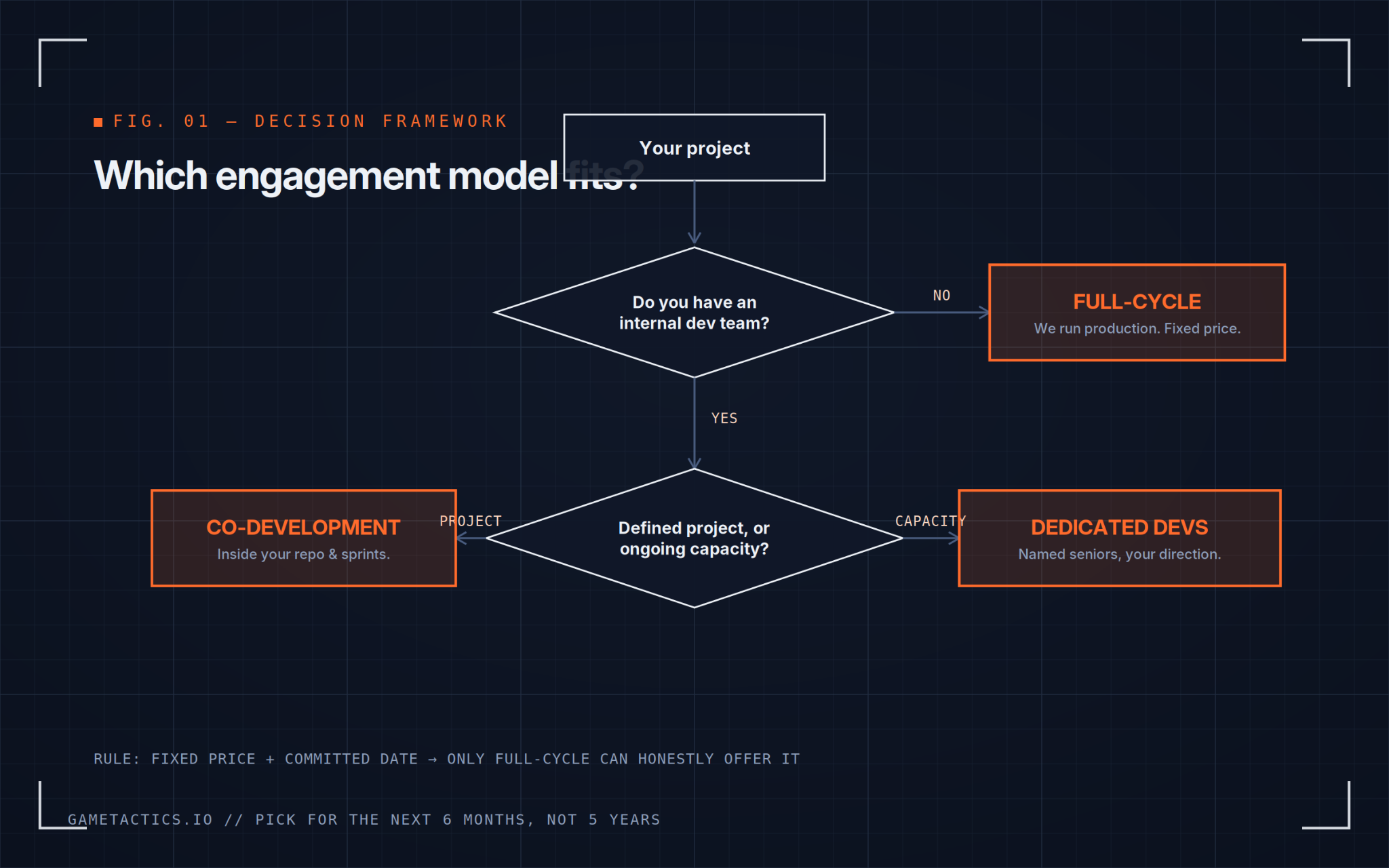
- Do you have an internal dev team? No, full-cycle. Yes, keep going.
- Is the work a defined project or ongoing capacity? A defined project inside an active production (a port, a feature, a system), co-development. Ongoing capacity on a live game, dedicated developers.
- Who should carry delivery risk? If you need a fixed price and a committed ship date, only full-cycle can honestly offer it. Co-dev and dedicated models price in flexibility instead of certainty, which is exactly what mid-production teams need, and exactly what first-time founders don't.
One more honest note: these models aren't permanent. A common path we see is an MVP built full-cycle, the founder raises or signs a publisher, the team grows, the engagement shifts to co-development, and eventually just a dedicated developer retained for LiveOps. Pick the model for the next six months, not the next five years.
Red flags a studio is selling you the wrong model
- They quote hourly for a project you described as fixed-scope. (They're keeping the risk on you.)
- They push full-cycle when you clearly have a working pipeline. (They want control, not fit.)
- A "ramp-up period" longer than two weeks before you see real output.
- No IP assignment language until you ask. You should own 100% of the code and assets, with repositories in your name, in every model.
- They can't name the engineers who'll be on your project.
Not sure which model fits? Tell us what you're building, a one-pager or just an idea, and we'll come back within 48 hours with a recommended engagement model, timeline, and fixed price.
RECOMMEND MY ENGAGEMENT MODEL→FAQ
What's the difference between co-development and outsourcing? Outsourcing usually means handing a scoped package to an external team who builds it in their own pipeline. Co-development means the external engineers work inside your repo, sprints, and review process, under your creative and technical leadership.
Can I switch models mid-project? Yes, and mature studios expect it. The cleanest switch points are at milestone boundaries, the end of an MVP, the end of a content season, or post-launch.
How fast can each model start? Dedicated developers: days. Co-development: a first reviewed PR within week one. Full-cycle: development typically starts within a week of an approved proposal, and we return a scoped proposal with timeline and fixed price within 48 hours of receiving a brief.
Which model is cheapest? Per hour, dedicated developers. In total cost-to-ship, it depends entirely on your ability to manage production. Teams without a producer almost always ship cheaper under full-cycle, despite the higher sticker price, because rework and drift are where budgets actually die.