1. Why Creative Is the Whole Game Now
Meta and Google have automated most of the targeting away. You feed the algorithm a conversion event and a budget — and the creative decides who stops scrolling. That makes ad creative the biggest lever left in mobile UA, as we covered in our guide to marketing a mobile app with AI.
- The algorithm finds the audience — the creative determines who converts
- Creatives fatigue in 2–4 weeks, so UA is a production treadmill, not a one-time shoot
- AI removes the production bottleneck; it does not remove the judgment
2. What a Winning Game Ad Shows
The first two seconds decide everything. Don't open with your logo. Don't explain your studio. Show the game doing the thing that makes it fun.
- Hook (0–2s): a challenge, a fail, or a satisfying moment. "You have 30 seconds to save your base" beats "Download our new strategy game!"
- Gameplay (2–15s): real footage of the core loop — decisions, near-misses, progress. Misleading gameplay gets ads rejected and buys users who churn instantly.
- Payoff: the win, the upgrade, the before→after base. Give the viewer the emotional close.
- CTA: one instruction. "Can you beat level 12?" outperforms three lines of feature copy.
3. Hook Formulas That Work for Games
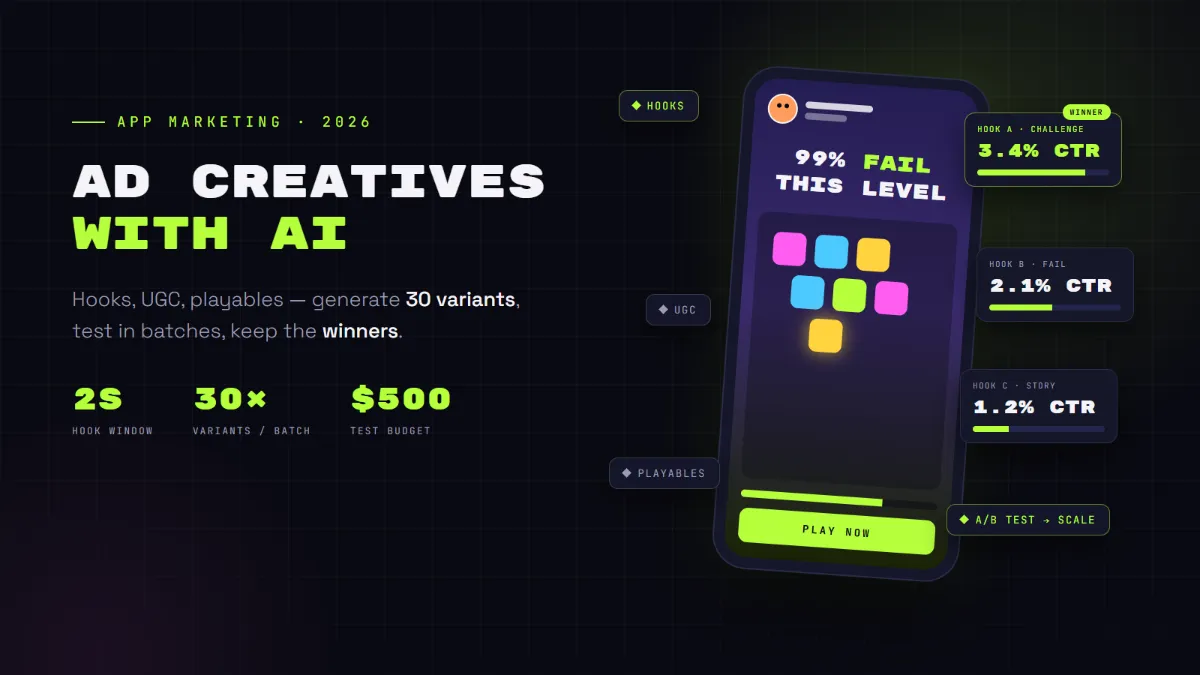
- Challenge: "99% of players fail this level." Dares the viewer to disagree.
- Fail: show a run going wrong — viewers stay to see the mistake, then want to do it better.
- Satisfying: sorting, merging, cleaning, perfect-fit loops. The ASMR of hyper-casual.
- Progression: day 1 base → day 30 empire. Sells the long-term fantasy in five seconds.
- Narrative: "They stole my dragon. I want it back." One sentence of story beats a feature list.
- Comparison: "Console graphics. On your phone." Positions against the player's expectations.
Use AI to generate 20 hooks per formula, then shortlist by hand. Volume is the point — your instinct picks better when it has options.
4. Ad Formats and What They Cost
| Format | Best For | Typical Production Cost |
|---|---|---|
| Gameplay-capture video (15–30s) | Hyper-casual, casual, puzzle | $0 – $300 with AI editing |
| UGC-style creator video | Simulation, midcore, lifestyle games | $150 – $800 |
| Static / banner | Retargeting, cheap reach tests | $0 – $100 |
| Playable ad | Casual games with a proven loop | $1,500 – $5,000 |
| Cinematic / 3D trailer | RPG and midcore brand pushes | $2,000 – $10,000+ |
Start with gameplay capture and UGC-style videos — they're cheap enough to test in batches. Playables come later, when you know which loop converts and the higher production cost is justified.
Frequently asked questions
What ad creative works best for RPG mobile games?
Start with the same hook formulas as any genre, such as challenge, progression and narrative hooks that show the real game in the first two seconds, then test UGC-style creator videos for a mid-core audience. A cinematic or 3D trailer suits an RPG or mid-core brand push at roughly $2,000 to $10,000 or more, but it should follow cheaper gameplay-capture and UGC-style tests rather than replace them. Never fake gameplay, because platforms reject it and the users it buys do not stay.
How do I use AI to create ad creatives for a mobile game?
Use AI to generate volume and keep people on the decisions. Generate about 20 hooks per formula and shortlist by hand, edit gameplay captures with AI at $0 to $300 per video, and run structured batches such as 5 hooks by 3 concepts by 2 CTAs, which is 30 variations, at $20 to $50 per day per batch. Then feed each batch's results back to AI to brief the next one, which is where the real advantage comes from.
How much does it cost to make a mobile game video ad?
With AI editing, a 15–30 second gameplay-capture video ad can cost $0 to $300 to produce, and a UGC-style creator video typically runs $150 to $800. Static banners cost $0 to $100, playable ads $1,500 to $5,000, and cinematic or 3D trailers $2,000 to $10,000 or more. Gameplay capture and UGC-style videos are cheap enough to test in batches, so start there.
How often should you refresh mobile game ad creatives?
Refresh before fatigue sets in, because top mobile game creatives typically decay within 2–4 weeks. That turns user acquisition into a production treadmill rather than a one-time shoot. Kill losing variants within 3–5 days, move budget to winners weekly, and feed each batch's results back into AI to brief the next one, so fresh creatives are ready before the current winners wear out.
How much budget do you need to test mobile game ad creatives?
A creative-testing budget of $500 to $1,500 is usually enough to find a direction before scaling spend. Run structured batches, such as 5 hooks × 3 concepts × 2 CTAs for 30 variations, at $20–50 per day per batch, which gives enough signal to rank variants. Treat those first batches as learning rather than profit: the goal is finding the hook and format your game deserves.
What makes a good hook for a mobile game ad?
A good hook shows the game doing something fun in the first two seconds: a challenge, a fail or a satisfying moment. "You have 30 seconds to save your base" beats "Download our new strategy game!" Proven formulas include challenge, fail, satisfying, progression, narrative and comparison hooks. Never open with a logo, and never fake gameplay, because platforms reject it and the users it buys don't stay.
Which metrics should I use to judge a mobile game ad creative?
Measure in order: hook rate, then CTR, installs per mille, CPI, activation and finally ROAS. Judging by CTR alone is a common mistake, because a creative with a great click-through rate and dead activation is a misleading ad, not a winner. The best creative is the one that buys users who activate and pay, so ROAS should outrank cheap CPI.
When should a mobile game start using playable ads?
Start using playable ads once you know which core loop converts. Playables suit casual games with a proven loop and cost $1,500 to $5,000 to produce, far more than gameplay-capture or UGC-style video, so they make sense after cheaper video batches have shown which mechanic players respond to. Until then, the higher production cost buys learning you could get more cheaply.