1. Start With the Right Analytics Setup
AI is only as good as the data you feed it. Before spending on ads or creatives, set up your analytics and measurement so you actually know what's working — and define your events before you start optimizing campaigns, not after.
Key things to set up:
- Events: install, first open, sign-up, tutorial start/complete, level complete, trial started, purchase, subscription — the actions that matter for your app.
- Funnels: map the core user journey and define conversion events. For a game: install → tutorial complete → level 5 → first purchase → D7 retention.
- Attribution: use a reliable MMP such as AppsFlyer, Adjust, Singular, or Tenjin so you know where users came from before running multiple channels.
- Cohorts & retention: track D1, D7, and D30 retention and key downstream actions per source, country, device, and creative.
- Revenue tracking: IAP, subscriptions, ad revenue, and ROAS — accurate purchase data is what every later optimization depends on.
iTip: build one simple funnel and make sure it's 100% accurate before you start optimizing. Bad data = expensive mistakes — don't wait until you've spent $20,000 to discover your attribution isn't trustworthy.
2. Understand Your Funnel (and Where You Leak Users)
Don't look at your app as one conversion. A typical mobile app funnel looks like this:
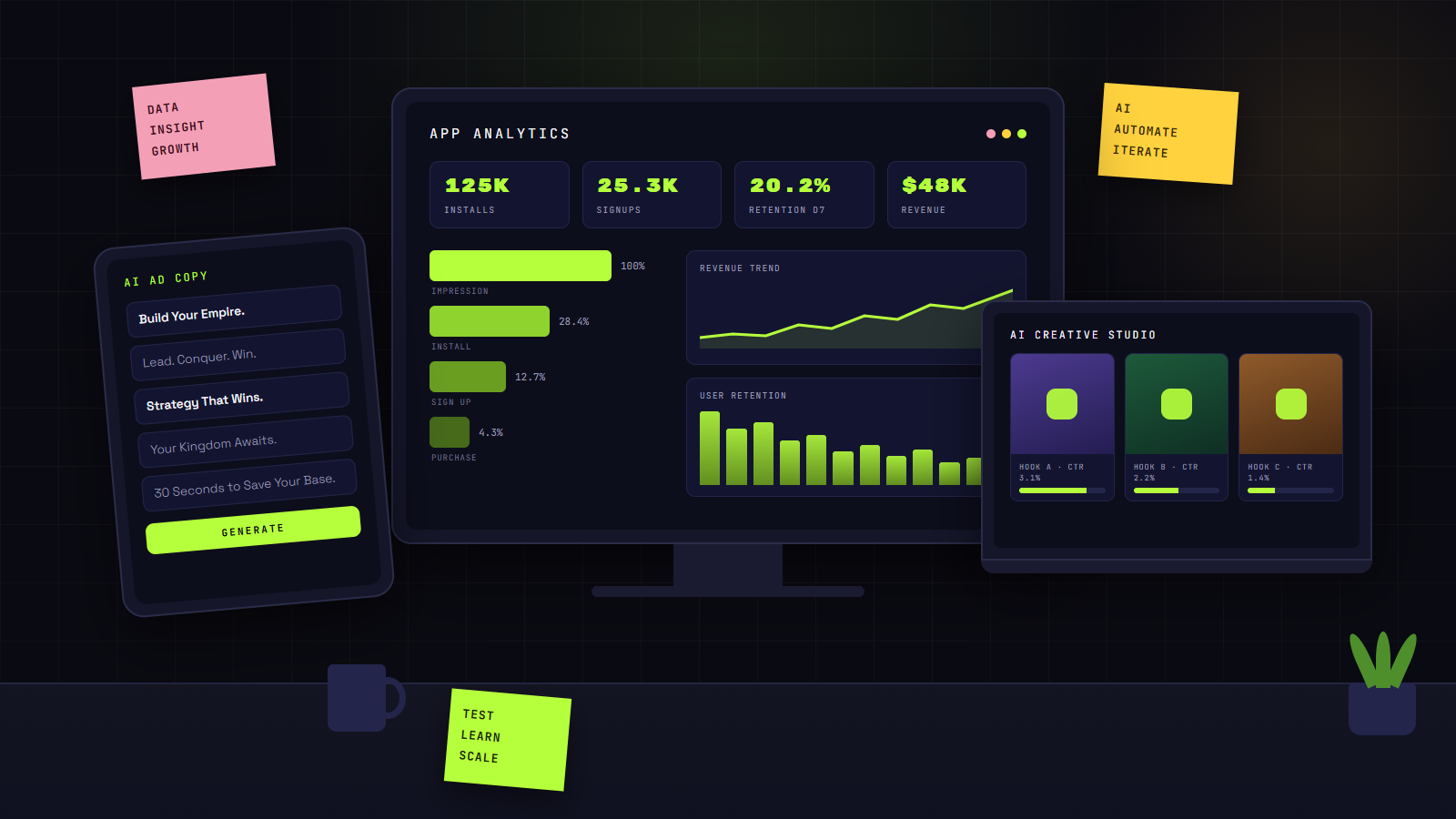
Imagine you spend $1,000 and get 5,000 installs. Sounds great — until only 1,000 complete onboarding, 300 use the core feature, 40 start a trial, and 10 pay. The problem may not be your advertising. It may be your onboarding.
Use analytics + AI to:
- Spot the biggest drop-off first — don't optimize everything at once
- Compare cohorts by source, country, device, creative, and campaign
- Find high-value user segments worth scaling
- Fix the product or funnel before increasing the ad budget
3. Grow with Paid Ads (AI-Powered Campaigns)
Paid ads are still one of the fastest ways to scale — the trick is using AI campaign types the right way. And don't chase cheap installs: a $0.80-CPI campaign whose users never purchase is more expensive than a $2.20-CPI campaign with strong retention. The question isn't "how cheap can I get an install?" — it's "how cheaply can I acquire a valuable user?"
Meta Ads
- Use Advantage+ campaigns for App Promotion
- Feed the algorithm meaningful events — purchase, subscription, high-value user — not just installs
- Test broad audiences and let the algorithm find buyers
- Move to value optimization once you have enough purchase data
Google Ads
- Use App Campaigns for installs and in-app conversions
- Let Google's AI optimize across Search, Play, YouTube, Display, and Discover
- Send meaningful in-app events back to Google Ads and choose goals that reflect the action you actually care about
tROAS Campaigns (Target ROAS)
- Best for scaling once you have enough purchase data — forced early, the algorithm has nothing to learn from and the campaign struggles to spend
- Follow the progression: installs → activation → purchase → conversion value / tROAS
- Set a realistic target from your unit economics — a 2.0x tROAS asks for $2 of tracked revenue per $1 of spend
- Remember ROAS is not profit: platform fees, refunds, servers, staff, and taxes still come out of it
4. AI for Ad Creative (Huge Leverage)
Creative is often the biggest lever in performance marketing. AI doesn't magically create winning ads — it lets you test 20 concepts instead of 3. Show the problem, then the app, then the result: "You have 30 seconds to save your base" beats "Download our new strategy game!"
Use AI to:
- Generate ad concepts, hooks, scripts, and storyboards — 20 opening lines, pain points, and problem/solution angles at a time
- Write high-converting primary text, headlines, descriptions, and CTA variations
- Build a testing machine: 5 hooks × 3 concepts × 2 CTAs = 30 variations, measured from hook rate through CTR, install rate, activation, and ROAS
- Produce UGC-style videos, screen recordings, and demo scripts — creative that feels like content regularly beats polished commercials
- Analyze your results as well: "here are 40 creatives — find the patterns between hook, format, audience, and purchase rate." Then ask what evidence supports the conclusion
!Real talk: AI can create 100 creatives, but humans still need to pick the winners. Don't let AI decide which creative is good — let it produce options, and let people judge.
5. Other Things That Matter (Don't Skip These)
- App Store Optimization (ASO): your ad makes a promise and your store page must continue it. Test outcome-focused screenshots — "Get a Workout Built for You in 30 Seconds" beats "AI Workout Planner." AI helps with keyword research, metadata, and A/B variants.
- Retargeting & remarketing: segment installed-but-never-activated, activated-but-no-purchase, trial-expired, and lapsed users — each group gets a different message.
- Push & in-app messaging: useful beats promotional ("Your upgrade is ready", not "COME BACK!!!"). Use AI to personalize timing, message variations, and segments.
- Email & CRM: build owned channels — welcome → useful feature → success story → offer. AI drafts and personalizes the sequence; the strategy comes first.
- Market & competitor research: mine competitor reviews for "I wish it could…" and "I hate that…" — AI can turn hundreds of reviews into customer-derived hooks, angles, and product improvements.
- Localization: adapt humor, visuals, offers, and pricing per market — don't just translate. AI multiplies output; native review still matters for key markets.
- Organic & communities: ASO, TikTok, YouTube, Reddit, Product Hunt, Discord. In communities, be useful instead of promotional — "check out my amazing new app!" convinces nobody.
6. Iterate, Learn, Scale
The best app marketers don't just run ads — they run experiments.
- Test one thing at a time and let data + AI guide your decisions
- Watch cohorts (D1 / D7 / D30), not just today's CPI — the cheapest channel often produces the worst users
- Follow the real KPI hierarchy: CPI → CPA → activation → retention → LTV → ROAS → profit
- Scale gradually — a campaign that works at $50/day doesn't automatically work at $5,000/day
- Automate reporting, variations, research, and analysis — never strategy, positioning, budget allocation, or creative approval
A sane starter budget: $500–$1,500 for creative testing, $1,000–$3,000 for Meta, $1,000–$3,000 for Google, plus ongoing ASO and content. The first budget's goal isn't profit — it's buying enough information to learn who converts, which creative works, and what a user is worth. Then scaling becomes rational. And if the product side is the bottleneck, our mobile game development team ships titles with analytics and UA hooks wired in from day one.
✓AI doesn't replace marketers.
It gives you superpowers — if you use it right. Don't use AI to create more marketing; use AI to learn faster: more hooks tested, more reviews analyzed, funnel leaks found sooner. Build → measure → learn → improve → test → scale. AI simply makes that loop faster.
Launching or scaling a mobile app or game? Tell us your product and market — we'll come back within 48 hours with a UA plan: analytics setup, campaign structure, creative strategy, and a testing budget.
PLAN MY APP GROWTH→