How Much Does an iOS Game Cost With AI in 2026?
Real iOS game budgets by tier — what Apple's platform changes about the cost, where AI actually cuts the bill, and a sample iPhone game budget.
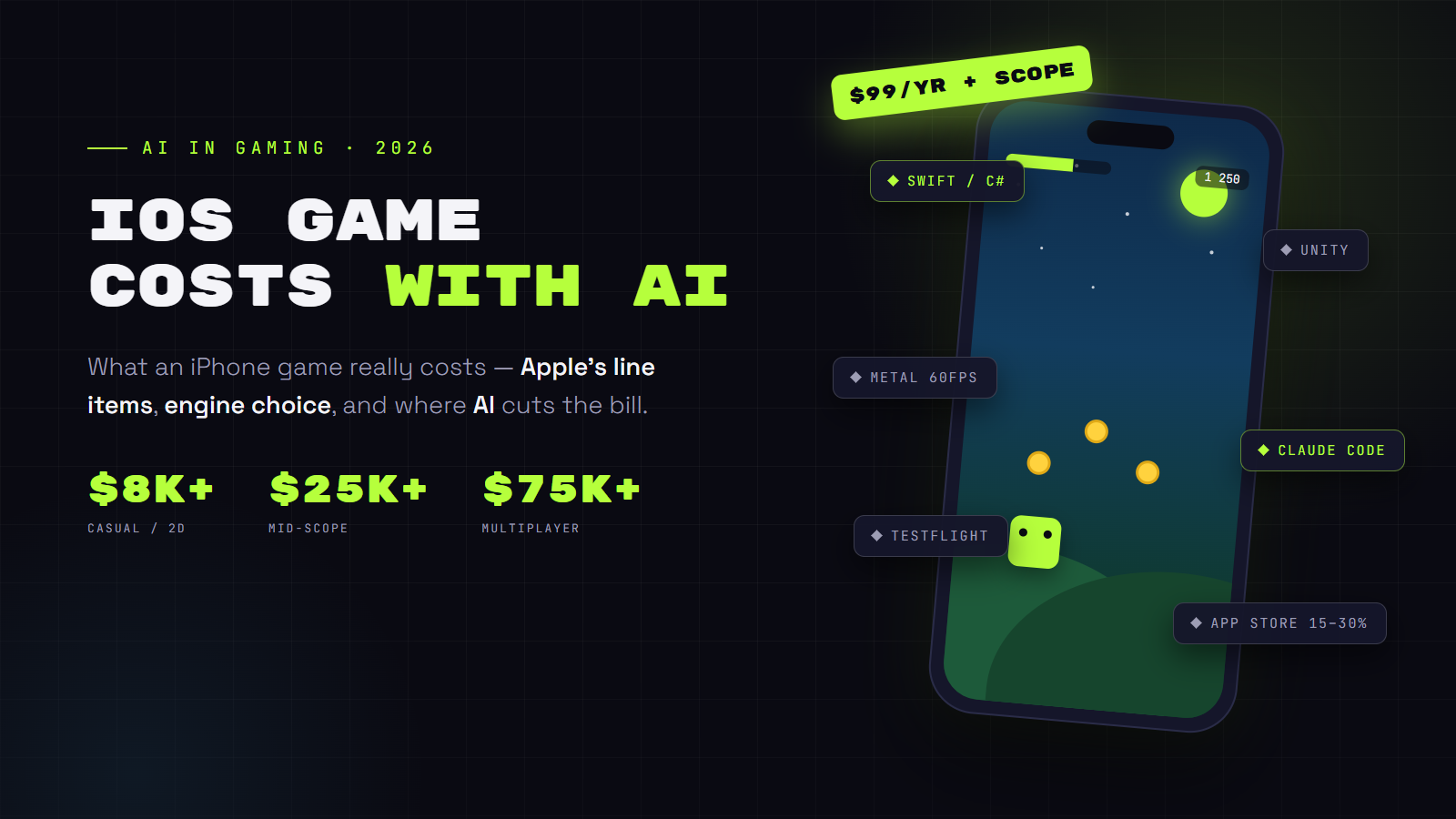
"How much does an iOS game cost?" gets asked as if Apple's platform were the main variable. It isn't. A match-3 game and a real-time multiplayer RPG are different projects on any platform — scope drives the budget, and AI changes how far that budget stretches. But iOS does add its own line items, review process, and player expectations, and this guide covers exactly those.
If you want the full scope-by-scope breakdown (genres, features, multiplayer, AI tools), start with our complete mobile game cost guide with AI. This article is the iOS lens on those numbers.
Quick Answer: iOS Game Cost With AI
For an indie team using AI tools effectively, reasonable planning ranges look like this:
| iOS Game Type | Approx. Budget (With AI) | Typical Timeline |
|---|---|---|
| Simple 2D Puzzle / Casual | $8,000 – $25,000 | 2–5 months |
| Polished Mid-Scope Game | $25,000 – $75,000+ | 4–10 months |
| Complex 3D Game | $50,000 – $150,000+ | 8–18+ months |
| Multiplayer / Live-Service | $75,000 – $250,000+ | 10–24+ months |
These are planning ranges, not fixed prices. A tightly scoped game from an experienced team can come in lower; custom art, heavy content, or live operations push it higher. The iOS platform itself moves the total far less than your feature list does.
What Makes iOS Different From Android
- Smaller, more uniform device matrix. You test against recent iPhones and iPads instead of thousands of Android configurations — QA on iOS is genuinely cheaper and faster.
- App Review. Every build and update goes through Apple's review (typically 1–3 days, longer with rejections). Budget a review-iteration buffer into your launch schedule.
- Higher player spend. iOS users historically monetize better — which also means they expect more polish. A rough UI that survives on Google Play gets punished on the App Store.
- TestFlight. Apple's built-in beta channel makes structured playtesting easy — use it before you spend a dollar on ads.
- App Tracking Transparency. ATT limits ad targeting on iOS, which makes creative quality and first-party analytics matter more — our guide on marketing a mobile app with AI covers how to work with that.
- Metal + modern hardware. Recent iPhones are powerful and consistent, so hitting 60fps is more about disciplined optimization than device-by-device firefighting.
iOS-Specific Cost Line Items
| Line Item | Typical Cost / Impact |
|---|---|
| Apple Developer Program | $99 / year |
| App Store commission on IAP | 15% (Small Business Program, under $1M/yr) – 30% |
| App Review iterations | Schedule buffer — plan 1–2 weeks around launch |
| iPad support | +10–20% UI/layout work if you support it properly |
| Game Center + iCloud saves | Days, not weeks — cheaper than a custom backend for basic needs |
| App Store screenshots + preview video | $500 – $2,000 if not included in your dev contract |
| Annual iOS/Xcode update maintenance | 15–20% of build cost per year — every September brings a new iOS |
Where AI Actually Cuts iOS Costs
AI doesn't discount every line of the budget equally. It compresses the repetitive middle of production — and leaves design, art direction, and judgment where they were.
| Area | AI Impact |
|---|---|
| Prototyping & gameplay scripting | Very High — AI coding agents (Claude Code, Cursor) build and refactor C# / Swift fast |
| Concept art & UI exploration | Very High — explore dozens of directions before committing |
| Boilerplate, debugging, documentation | High |
| ASO metadata & screenshot copy variants | High |
| QA automation & test generation | Medium–High |
| Game design, art direction, final polish | Low — still human work |
In practice that means an iOS game that would have needed a 6–8 person team can often ship with 3–4 people directing AI-accelerated production — the savings come from headcount and calendar time, not from skipping steps.
Engine Choice: Unity, Unreal, or Native Swift?
- The default for indie iOS — 2D, casual, strategy, simulation, stylized 3D
- One codebase keeps the Android door open for +10–15%, not a rebuild
- Largest asset store and AI-tooling ecosystem
- High-fidelity 3D on recent iPhones
- Best when console-quality visuals are the selling point
- Heavier builds and pipeline — justify it with your art direction
Native Swift (SpriteKit/Metal) makes sense only for very simple 2D games or unusual technical needs — for everything else, a cross-platform engine is cheaper over the game's life. If you're weighing engines, our Unity game development team ships iOS titles in both, and we wrote a full Unity vs Unreal comparison.
Example: Mid-Scope iOS Game Budget
A stylized single-player iOS game — core loop, progression, missions, cloud save, ads + IAP, professional UI, iPhone + iPad:
| Area | Example Budget |
|---|---|
| Game Design & Planning | $2,000 – $5,000 |
| Programming (AI-accelerated) | $8,000 – $20,000 |
| UI/UX (HIG-compliant, safe areas, iPad layouts) | $2,500 – $6,000 |
| 2D/3D Art | $5,000 – $15,000 |
| Animation & VFX | $2,000 – $7,000 |
| AI Tools & Software | $500 – $3,000 |
| QA & Device Testing (iPhone + iPad) | $2,000 – $5,000 |
| Backend / iCloud / Cloud Save | $1,000 – $5,000 |
| App Store Prep + ASO | $500 – $2,000 |
| Contingency | $3,000 – $7,000 |
iOS-Only, or iOS + Android?
With a cross-platform engine, adding the second platform costs roughly 10–15% more (store compliance, device QA, platform services) — not a second build. Launch iOS-first when your genre monetizes on spend-per-player and you want App Review polish pressure early; launch both when your growth plan is ad-driven volume. A mobile game development partner that ships both platforms from one codebase keeps that decision cheap to change later.
How to Keep an iOS Budget Under Control
- Scope is the budget: 10 excellent levels beat 50 mediocre ones
- Build an MVP first — a playable TestFlight build in weeks tells you more than a spec ever will
- Use AI where it creates leverage (repetitive code, concepts, docs, tests) and humans where judgment matters (design, direction, polish)
- Don't skip the App Review buffer — a rejection two days before your marketing push is an expensive surprise
- Budget 15–20% per year for post-launch: iOS updates, store policy changes, and content
Scope drives the budget on every platform. Apple adds predictable line items — the $99 program, 15–30% commission, review cycles, iPad support — and AI compresses the repetitive work in between. Budget for the game you can polish, not the biggest one you can imagine.
Have an iOS game in mind? Our iOS game development team ships from concept to App Store — design, code, art, QA, and submission under one roof.
Tell us your concept — genre, features, platforms — and we'll return a scoped proposal with a fixed price within 48 hours.
GET AN iOS GAME QUOTE→FAQ
What's the cheapest an iOS game can cost? A polished single-mechanic casual game starts around $8,000–$12,000 with AI-assisted production — including design, development, basic art, and App Store submission. Below that you're buying a prototype, not a launchable game.
Is an iOS game cheaper than an Android game? Development cost is nearly identical with a cross-platform engine. iOS QA is usually a bit cheaper (fewer devices), while Android QA is broader. Building both together adds roughly 10–15% over one platform.
How long does an iOS game take to build? Simple casual games: 2–5 months. Mid-scope: 4–10 months. Complex 3D or multiplayer: a year or more. Add 1–2 weeks of App Review buffer around launch.
How much does AI actually save? On the right tasks — prototyping, gameplay code, debugging, concept art, documentation — teams commonly cut 20–40% of the hours. It doesn't reduce design, art direction, or QA judgment, which is why total budgets shrink but don't collapse.