Building a mobile game used to require a large development team, months of production, and a significant budget for programming, art, design, animation, testing, and backend infrastructure. AI is changing that equation.
Today, an indie team can use AI-assisted development and generative AI tools to prototype gameplay faster, create concept art, generate supporting assets, write and refactor code, produce documentation, and automate parts of QA.
But does that mean you can build a complete mobile game for a few thousand dollars? Not necessarily. AI can reduce development time and production costs, but the final cost of a game still depends heavily on its genre, features, visual quality, multiplayer requirements, UI/UX, content volume, backend infrastructure, and level of polish.
A simple 2D puzzle game and a real-time multiplayer strategy game are completely different projects, even if both are called "mobile games." For an indie team using AI effectively, a small-to-medium mobile game can be developed on a much more manageable budget than a traditionally produced game. The important part is knowing where AI can reduce costs and where human expertise is still essential.
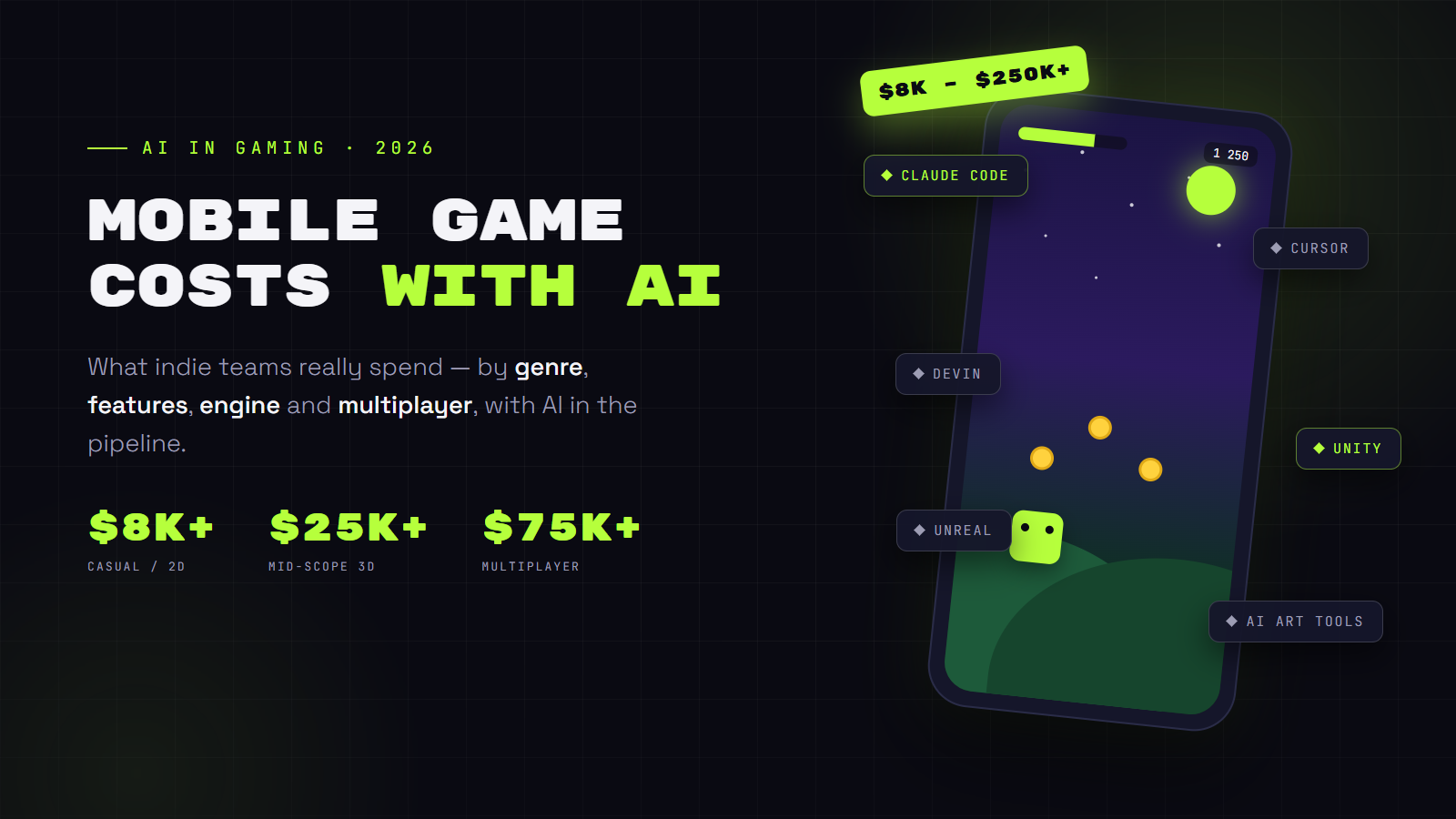
Quick Answer: How Much Does a Mobile Game Cost With AI?
For an indie team using AI tools effectively, a reasonable planning range looks like this:
| Game Type | Approx. Budget (With AI) | Development Time |
|---|---|---|
| Simple 2D Puzzle / Casual | $8,000 – $25,000 | 2–5 months |
| 2D Strategy / Simulation | $15,000 – $45,000 | 4–8 months |
| Mid-Scope 3D Casual Game | $25,000 – $70,000 | 5–10 months |
| 3D Strategy / RPG | $50,000 – $150,000+ | 8–18+ months |
| Multiplayer / Live-Service Game | $75,000 – $250,000+ | 10–24+ months |
These are planning ranges, not fixed prices. Final cost depends on scope, content, team expertise, and long-term live operations. A highly experienced team may deliver a smaller game for less, while custom art, complex backend systems, or heavy content can cost substantially more.
AI changes the economics mainly by reducing the amount of repetitive work. It does not eliminate the need for game designers, programmers, artists, technical artists, QA testers, producers, and other specialists.
What Actually Determines the Cost of a Mobile Game?
The cost of a game is not determined by the number of screens or the number of developers. A better way to estimate the budget is to break the project into layers:
- Genre, core features, and community/social features
- Design, UI, graphics, and content volume
- Development complexity and AI-assisted production
- Game engine, multiplayer, and backend infrastructure
- Testing, optimization, publishing, and post-launch support
This breakdown gives you a much more realistic estimate than simply asking: "How much does it cost to make an iOS game?"
1. Genre: The Biggest Cost Driver
The first question should always be: what type of game are you building? Different genres require completely different amounts of content, systems, art, animation, AI, networking, and balancing. Here are five common categories.

Simple mechanics, light content, small systems. Most affordable.
Interconnected systems, economy, AI logic, longer development.

High content volume, characters, quests, skills, cutscenes.

Networking, servers, matchmaking, anti-cheat, scalability.
Ongoing content, seasons, events, community, live ops.
Casual and Puzzle Games
Match-3, word games, card games, physics puzzles, endless runners, and simple arcade games are usually among the most affordable mobile games to develop. A small indie team can build a polished casual game with one core gameplay loop, limited environments, simple character systems, basic progression, ads or in-app purchases, a lightweight UI, and limited backend requirements.
AI is particularly useful here because the game has relatively straightforward programming and a manageable number of assets.
Strategy and Simulation Games
City builders, farming games, tower defense, idle games, resource management, and base-building games usually require multiple interconnected systems. A building system may connect to resources → workers → production → upgrades → progression → economy → missions. Changing one system affects several others, so the development cost increases even if the graphics are relatively simple.
AI can help accelerate gameplay scripting, data structures, UI logic, tools, debugging, documentation, basic content generation, and balancing experiments — but the game still requires strong system design and testing.
RPG and Adventure Games
RPGs typically become expensive because of content volume: characters, environments, quests, dialogue, inventory, combat, skills, equipment, progression, enemies, animations, VFX, audio, save systems, tutorials, and multiple levels. The programming is only one part of the budget — the bigger challenge is usually content production.
Generative AI can help with ideation, concept development, dialogue drafts, placeholder assets, and certain production tasks, but production-quality RPG content still requires human review and art direction.
Real-Time Multiplayer Games
Multiplayer can dramatically increase the budget. A single-player game might only need Player → Game → Save Data. A multiplayer game requires server infrastructure, matchmaking, player authentication, network synchronization, player profiles, leaderboards, anti-cheat systems, moderation, cloud storage, analytics, live operations, and scalability.
And that does not necessarily include the long-term operating cost of servers and live services.
Live-Service and Social Games
The most expensive category is often not the initial game itself — it is the game that must continuously produce new content: seasons, events, new characters, new maps, daily missions, leaderboards, guilds, clans, chat, competitive systems, battle passes, live economy balancing, and regular updates. The development team effectively becomes a long-term content operation.
A serious live-service game can easily move beyond the typical indie budget into six- or seven-figure development and operating costs. AI can help the team produce more content with fewer people, but it doesn't eliminate the ongoing cost of operating the game.
The Second Major Cost Factor: Features
After deciding the genre, create a feature list. This is where many game budgets go wrong. A client might say "I want a simple strategy game" — but the actual feature list contains base building, resource collection, character progression, missions, quests, combat, inventory, equipment, achievements, daily rewards, notifications, leaderboards, friends, guilds, PvP, multiplayer, cloud saves, ads, and in-app purchases. That is no longer a simple game.
A better way to estimate features is to divide them into three categories:
- Core features — required for the game to function: main gameplay loop, player controls, level system, basic progression, save system, main UI.
- Secondary features — improve retention: daily rewards, achievements, missions, character upgrades, inventory, statistics, events.
- Advanced features — significantly increase development complexity: real-time multiplayer, PvP, guilds, voice chat, advanced matchmaking, procedural generation, live economy, player trading, cross-platform progression.
The easiest way to reduce a game budget is often to reduce feature complexity, not developer quality.
Community Features Can Change the Budget Completely
A game with no community system is fundamentally different from a social game. A basic single-player game might only require Player + Game + Local/Cloud Save. Adding friends, guilds, clans, leaderboards, global chat, private messaging, player profiles, social feeds, sharing, competitive rankings, reporting, moderation, blocking, and notifications introduces development, backend, testing, security, and moderation requirements for every feature.
Adding a leaderboard sounds simple. But a production leaderboard may require database architecture, score validation, server-side verification, ranking calculations, pagination, anti-cheat protection, UI, error handling, and analytics. That is why feature count alone is not enough — you have to consider the infrastructure behind each feature.
Design and UI: AI Can Help, But It Doesn't Replace Design
A game with 10 simple screens is very different from a game with a complex HUD, inventory, character management, upgrade screens, shop, missions, notifications, social menus, map, settings, tutorials, and multiple dynamic popups.
Generative AI can accelerate the design process by helping create moodboards, concept screens, UI directions, icons, background and character concepts, texture ideas, marketing graphics, and prototype assets. But there is a major difference between an AI-generated concept and a production-ready game asset. A professional UI still needs consistency, typography, hierarchy, interaction states, responsive layouts, accessibility, animation, platform-specific behavior, and art direction.
AI reduces the time required to explore ideas. It does not automatically create a complete UI system.
How Generative AI Can Reduce Game Art Costs
Generative AI is particularly useful during the early and middle stages of production. A team can use it to explore:
- Concept art — multiple visual directions before commissioning or producing final assets
- Environment concepts — forests, cities, dungeons, sci-fi environments, fantasy worlds, buildings, backgrounds
- Character concepts — variations for heroes, NPCs, enemies, bosses, creatures
- UI concepts — menus, HUD, buttons, inventory screens, shop screens, reward screens
- Marketing assets — store screenshots, promotional images, social media creatives, ad and thumbnail concepts
The important workflow is: AI generation → human selection → refinement → production asset → integration → QA. Not: AI generation → ship immediately.
AI Tools Used in Game Development
The AI toolchain is becoming another part of the development stack — different tools are useful at different stages.
- Midjourney / DALL-E / Firefly — concept art, environments, characters, UI ideas
- ChatGPT / Claude — design documents, game ideas, narrative
- Runway / Pika — motion graphics, trailers, animation pre-visualization
- Claude Code — code understanding, feature implementation, refactoring
- Cursor — AI-assisted coding, agents, debugging, project-wide context
- Devin — autonomous engineering tasks, testing, refactoring, bug fixing
The key benefit of generative image tools is not simply "free art." The bigger advantage is speed of iteration: instead of spending days exploring a visual direction, an artist or designer can explore dozens of directions much faster and then refine the strongest one.
Claude Code
Claude Code works as an AI coding agent that helps developers work through a codebase, implement features, debug issues, refactor systems, and perform repetitive engineering tasks. AI coding agents are most useful when the developer provides clear requirements and reviews the generated work.
Cursor
Cursor has evolved beyond simple autocomplete into an AI-assisted development environment with agents that can understand a codebase and work on development tasks, including cloud agents that produce changes from scoped tickets. For game development it is useful for C# scripting, gameplay systems, editor tools, UI logic, debugging, refactoring, documentation, and repetitive code.
Devin
Devin positions itself as an AI software engineer that can write, run, and test code, and work on bugs, refactoring, and testing. That makes it interesting for teams with large backlogs of smaller engineering tasks: "fix these five independent UI bugs," "add unit tests for these systems," "refactor this repetitive code." These are much better AI-agent tasks than "build my entire game" — even Devin's own documentation recommends breaking larger projects into smaller, clearly scoped tasks with specific success criteria.
Unity vs Unreal: Which Engine Should an Indie Team Use?
The engine you choose can influence both development speed and cost.
- Great for 2D, casual, strategy, and simulation games
- Large asset store and strong mobile optimization
- Faster iteration for indie teams
- Investing heavily in AI-assisted workflows (in-editor assistant, AI Gateway, generators)
- High-end 3D graphics and advanced rendering
- Best for RPG, action, and high-fidelity games
- Strong optimization capabilities for high-end mobile experiences
- More demanding, but visually powerful
Using a more powerful engine does not automatically make a game cheaper. If the project doesn't require advanced visual capabilities, a simpler production pipeline is usually more efficient.
AI Does Not Make Multiplayer Cheap
This is one of the most important points in modern game development. AI can help write networking code, debug server issues, generate boilerplate, and build backend tools. But multiplayer still requires infrastructure, servers, databases, authentication, networking, security, scalability, monitoring, analytics, testing, moderation, and maintenance — and multiplayer games must be tested under conditions that are difficult to reproduce in a simple development environment.
- Single-player → cheapest
- Async multiplayer → moderate
- Real-time multiplayer → significantly more expensive
- Large-scale live service → potentially very expensive
How Much Can AI Actually Reduce Development Costs?
The answer depends on the project — AI is unlikely to reduce every category by the same percentage.
| Development Area | Potential AI Impact |
|---|---|
| Prototyping | Very High |
| Concept art | Very High |
| Boilerplate programming | High |
| Debugging | High |
| Documentation | High |
| UI exploration | High |
| Repetitive asset production | Medium–High |
| QA automation | Medium–High |
| Game design decisions | Low–Medium |
| Multiplayer architecture | Low–Medium |
| Final art polish | Low–Medium |
| Art direction | Low |
| Product strategy | Low |
The biggest mistake is treating AI as a replacement for a development team. A better model is: human direction + AI acceleration + automated workflows.
Example: A Moderate-Budget Indie Mobile Game
Imagine an indie team building a stylized 3D strategy game: base building, resource collection, 20–30 buildings, 10–15 characters, an upgrade system, missions, progression, basic combat, single-player gameplay, cloud save, ads, in-app purchases, and a professional UI on Android + iOS. No real-time multiplayer. A possible budget might look like:
| Area | Example Budget |
|---|---|
| Game Design & Planning | $2,000 – $5,000 |
| Programming | $8,000 – $20,000 |
| UI/UX | $2,000 – $6,000 |
| 2D/3D Art | $5,000 – $15,000 |
| Animation & VFX | $2,000 – $7,000 |
| AI Tools & Software | $500 – $3,000 |
| QA & Device Testing | $2,000 – $5,000 |
| Backend / Cloud | $1,000 – $5,000 |
| Publishing & Store Preparation | $500 – $2,000 |
| Contingency | $3,000 – $7,000 |
This is a much more realistic way to think about an AI-assisted indie game. AI does not magically make a $75,000 project a $5,000 project. Instead, it helps an experienced team produce a $75,000-quality result with a smaller team and/or a shorter schedule.
What If the Same Game Uses Multiplayer?
Now add player accounts, matchmaking, PvP, leaderboards, friends, clans, server-side game state, anti-cheat, notifications, analytics, and moderation. A project that might have cost $30,000–$70,000 can become $75,000–$150,000+ depending on the architecture and level of polish. And the important difference is that the additional cost does not stop at launch — you now have recurring infrastructure and live-operations expenses.
The Real Cost Formula for an AI-Assisted Game
Game Cost = Genre + Features + Content + Design + Development + Backend + Multiplayer + QA + Polish + Launch + Maintenance. AI then acts as an efficiency multiplier across several of these categories.
This is why asking "how much does AI cost?" is less useful than asking "how much development work can AI remove or accelerate in this specific project?"
Where Should an Indie Team Spend Money?
If you're an indie studio, don't try to use AI to replace every specialist. Spend money on the areas where human expertise creates the most value:
- Game design — a bad game concept cannot be rescued by faster coding
- Core gameplay — the first 30 minutes of the player experience matter enormously
- Art direction — AI can generate thousands of images; someone still needs to decide what belongs in the game
- UX/UI — players should understand what to do without thinking about the interface
- QA — AI-generated code still needs testing
- Optimization — mobile devices vary enormously in performance
- Multiplayer architecture — if multiplayer is core to the game, invest in experienced engineering
Where AI Provides the Most Value
For an indie team, the ideal workflow is not "let AI build the game." It is "let AI handle the repetitive work so the team can spend more time on the game."
- Traditional workflow: Designer → Developer → Artist → Developer → QA → Developer → Release
- AI-assisted workflow: Designer → AI Prototype → Developer Review → AI Implementation → Artist Refinement → Automated QA → Human QA → Release
The second workflow can dramatically shorten iteration cycles.
The Most Important Cost-Saving Strategy: Reduce Scope
If your budget is $30,000, don't try to build a $300,000 game with AI. Build a great $30,000 game.
- Instead of 100 characters — build 10 excellent characters
- Instead of 50 levels — build 15 highly polished levels
- Instead of real-time multiplayer — start with single-player or asynchronous competition
- Instead of 10 systems — build 3 systems that work extremely well together
AI becomes much more powerful when the scope is controlled.
A Practical Indie Game Development Stack
- Game engine — Unity for mobile-focused, 2D, stylized 3D, strategy, simulation, and casual projects; Unreal Engine when high-end 3D visuals and rendering justify the additional complexity
- Programming — Claude Code, Cursor, Devin, IDE tooling, GitHub
- Visual development — generative image tools, Photoshop or equivalent, Blender, engine asset workflows
- Project management — Jira, Linear, Notion, GitHub Projects
- Testing — automated tests, device testing, AI-assisted bug investigation, human QA
The exact stack should depend on the team's experience and the game, rather than simply choosing the most popular AI tools.
So, How Much Does an iOS Game Cost With AI?
The answer is similar to Android or cross-platform mobile development, because the iOS platform itself is not what determines most of the budget — the game's scope does.
- Small indie iOS game — $8,000–$25,000
- Polished mid-scope game — $25,000–$75,000+
- Complex 3D game — $50,000–$150,000+
- Multiplayer or live-service game — $75,000–$250,000+
What About an Android + iOS Game?
Building for both platforms is highly efficient when the engine and architecture are designed for cross-platform development: instead of building an iOS version and an Android version from scratch separately, a cross-platform engine allows a shared game codebase with platform-specific adjustments. You still need to test different screen sizes, performance, touch controls, OS versions, store requirements, device-specific issues, notifications, payments, and platform services — cross-platform reduces duplicated development work, but it does not remove QA.
What AI Changes About the Game Development Business
The biggest change may not be that games become cheaper. It is that smaller teams can attempt larger projects. A studio that previously needed 2–4 programmers, 2–5 artists, a UI designer, a game designer, QA, a technical artist, and a producer might accomplish similar early production with a smaller core team, using AI for repetitive engineering, prototyping, concept generation, documentation, and production support. But the smaller team needs to be more skilled at directing the process. AI increases leverage — it does not remove responsibility.
Final Verdict: Is AI Making Mobile Games Cheaper?
Yes — but not in the way many people think. AI is making prototyping, coding, debugging, concept art, UI exploration, documentation, testing, content ideation, and repetitive production faster. But the biggest costs can still come from game design, art direction, production-quality assets, animation, complex gameplay, multiplayer, backend infrastructure, QA, optimization, live operations, and human expertise.
For an indie team, the biggest opportunity is therefore not "build a game without developers." It is "build a better game with a smaller, more efficient team." With a controlled scope, a strong game concept, an experienced development team, and the right AI workflow, the cost of creating a professional mobile game is significantly more manageable than it was a few years ago.
AI doesn't replace developers — it amplifies them. It reduces repetitive work, accelerates production, and helps indie teams build bigger and better games with smarter budgets. Focus on a strong core loop, controlled scope, and the right tools.
Mobile Game Cost Calculator: Start With These Questions
Before requesting a development quote, answer these questions:
- Game — what is the genre? 2D or 3D? Single-player or multiplayer? What is the core gameplay loop?
- Content — how many levels, characters, environments, buildings, items, and weapons?
- Features — progression, inventory, missions, achievements, ads, in-app purchases, social features?
- Community — friends, guilds, leaderboards, chat, PvP, matchmaking?
- Design — custom UI, custom animations, custom VFX, custom art style?
- Technology — Unity or Unreal? iOS, Android, or both? Backend, cloud save, multiplayer servers?
- AI — which tools will be used, which assets and code tasks can be AI-assisted, and what still requires human production?
Once these questions are answered, a mobile game development company can produce a much more accurate estimate.
Have a game concept and want a real number instead of a range? Send us a brief — genre, features, and platforms — and we'll return a scoped proposal with a fixed price within 48 hours.
GET AN AI-ACCELERATED QUOTE→The Bottom Line
The cost of a mobile game is no longer simply a calculation of developers × months. It is a combination of genre + features + content + design + technology + multiplayer + QA + AI efficiency + post-launch operations.
Use AI where it creates leverage. Use humans where judgment, creativity, quality, architecture, and player experience matter. That combination is what makes modern indie game development more accessible without sacrificing the quality players expect.