Artillery Tycoon
Full-Cycle Original IP from Concept to Steam Early Access
PROJECT OVERVIEW
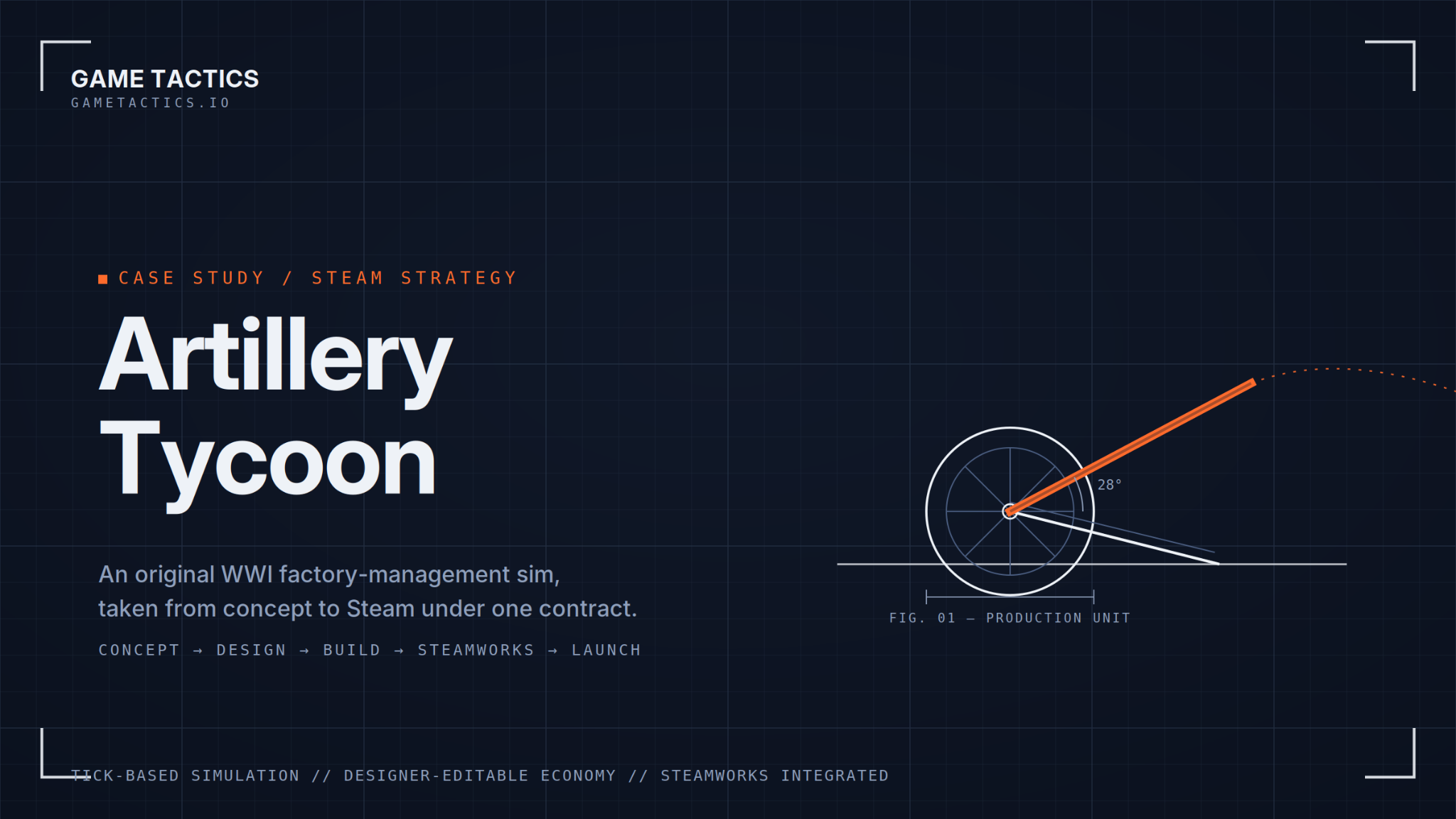
Artillery Tycoon is an original WWI-era factory management sim where players research authentic weapon components, engineer complete artillery pieces, prove them on a firing range, and compete for government contracts. Game Tactics designed, built, and shipped it on Steam, concept to storefront under one contract, and released it into Early Access in April 2025 where it is live and updating.
PROJECT CONTEXT
Mobile-first studios often stumble on Steam. PC strategy players expect systemic depth, dozens-of-hours progression, keyboard-and-mouse-native UI, and a level of simulation fidelity that mobile design instincts do not prepare you for, and the Steam audience punishes shallow tycoon games brutally in reviews. Artillery Tycoon set out to earn that audience: research breech mechanisms, recoil systems, and firing platforms, engineer complete artillery pieces, test prototypes on a firing range, and win government contracts. Miss the test-fire, lose the contract.
KEY REQUIREMENTS
- Simulation depth that stays performant: an economy of interlocking systems, component research, warehouse and production management, contracts, and test firing, running smoothly even in sprawling late-game factories.
- A tycoon UI that respects PC players: dense information (production stats, contract terms, research trees) that stays readable and mouse-efficient across resolutions.
- Steam as a platform, not just a store: Steamworks integration, a store page built for conversion, and a production setup that could sustain a public Early Access update roadmap after launch.
OUR CONTRIBUTION & EXECUTION
- A simulation architecture built for the late game: the production sim is tick-based and decoupled from the render loop, with production chains resolved in batched updates rather than per-machine per-frame calls. Late-game factories stay smooth because cost scales with ticks, not frame rate.
- A designer-editable economy: component costs, contract payouts, and research pricing live in data, so balance evolves update after update without touching engine code.
- Contract and progression design that creates "one more turn": short-term contracts layer against long-term research bets, so the player always has a near-term goal and a strategic gamble running at the same time.
- Full Steamworks integration and a store page built for conversion, capsule art, screenshots sequenced to show depth progression, and copy aimed squarely at the simulation and strategy audience.
- A live Early Access roadmap delivered on: tutorial voice-over, research content, balance passes, and bug fixing shipped continuously since the April 2025 launch, driven by player feedback from Steam discussions and Discord.
DELIVERABLES
- Original game design and full production, concept to Steam launch
- Tick-based simulation architecture for stable late-game performance
- Data-driven, designer-owned economy and research trees
- PC-native tycoon UI/UX across resolutions
- Steamworks integration, store page, and an ongoing Early Access update cadence
TOOLS & TECHNOLOGY
RESULTS
Shipped on Steam as an original IP taken from concept to storefront under one contract. It launched into Early Access in April 2025 with a public update roadmap and has delivered on it: successive content and polish updates post-launch, balance and content shaped by player feedback on Steam and Discord, and full economy rebalances shipped without engineering releases. Sustaining a live Early Access cadence, not just reaching launch, is what the architecture was built for.
SEE OTHER RELATED WORK
ALL CASE STUDIES →


FREQUENTLY ASKED
Can a mobile studio really ship a credible Steam strategy game?
How do you keep a tycoon sim smooth in the late game?
What does full-cycle mean for an original IP like this?
Do you support a game after it launches on Steam?
TURNING YOUR VISION
INTO SUCCESS.
Tell us a bit about your project and we'll come back within 48 hours with an engagement model, timeline, and fixed price.