How Much Does It Cost to Make a Match-3 Game?
What a match-3 game costs in 2026: budget by scope, why levels and the meta layer matter more than the match mechanic, how long it takes and what Candy Crush-scale content costs.
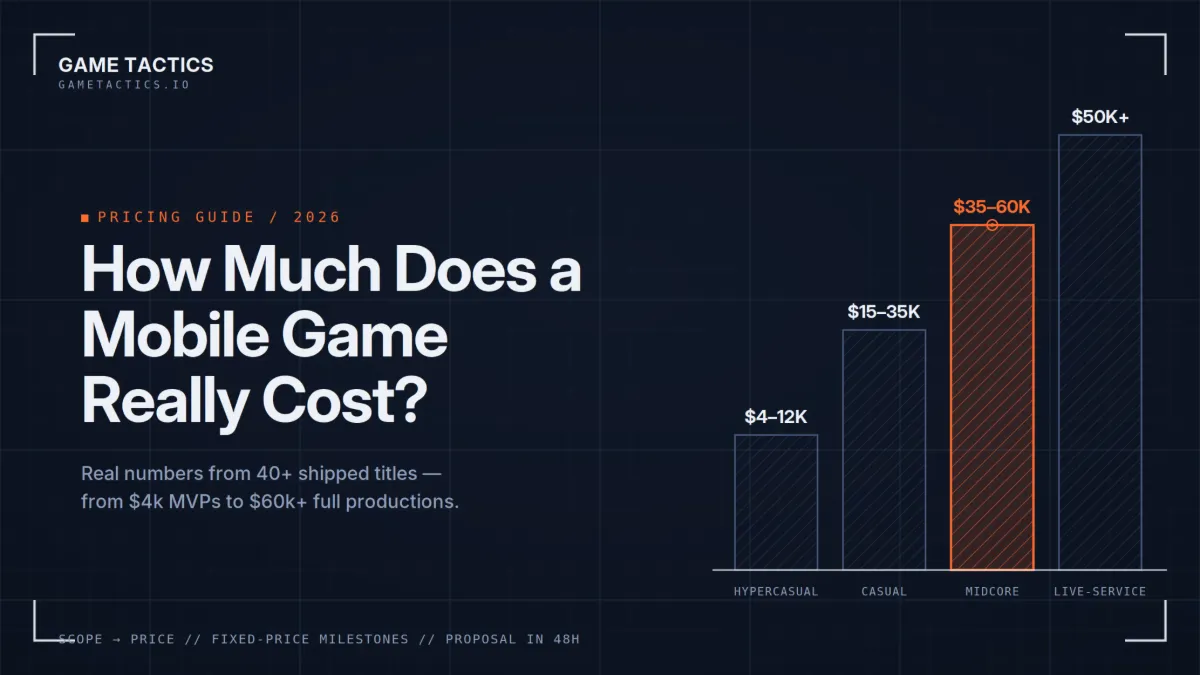
A match-3 game is a casual title, which we scope at $15,000 to $35,000 for a launchable version with meta progression, built in about 3 to 5 months. The budget depends on level count, the meta layer (decorating, story, collections) and LiveOps tooling, not on the match mechanic itself. Candy Crush-scale content and events cost far more.
This is based on 40+ titles shipped in Unity, including match-3 and other casual puzzle games such as Potion Pop: Match 3, and on the casual row of our mobile game cost guide.
Budget $15,000 to $35,000 and 3 to 5 months for a launchable casual match-3 with meta progression. Spend the money on level design, the meta layer and live events, not on the swap-and-match mechanic, which is the cheapest part to build.
What does a match-3 game cost to develop?
The match mechanic (swap, match, cascade, boosters) is a solved problem and takes a small share of the work. What fills the budget is everything around it. These are the same bands we publish for casual games in general.
| Scope | Typical budget | Typical timeline | What you get |
|---|---|---|---|
| Playable MVP | From $4,000 | 4 weeks | Core loop, a first batch of levels and a few boosters, enough to test retention and CPI |
| Launchable casual match-3 | $15,000 to $35,000 | 3 to 5 months | Polished art, a level set with a tuned difficulty curve, a meta layer, ads and IAP, store submission |
| Content-heavy, live-service match-3 | Above $35,000, plus yearly upkeep | 6 months and ongoing | Events, team or social features, large level set, remote config and a LiveOps calendar |
A second mobile platform adds roughly 10 to 15 percent when the game is built in Unity from the start, and soft launch media is a separate $5,000 to $40,000 line.
What actually drives the cost of a match-3 game?
How many levels does a match-3 game need at launch?
Enough levels to carry a new player through the first week or two of play, with a tuned difficulty curve, and a pipeline to add more. Match-3 games are content treadmills: a hundred hand-tuned levels cost more than the mechanic that plays them, and players finish levels faster than you can build them. Budget level design time and difficulty tuning, not just implementation.
Why does the meta layer cost more than the match board?
The meta layer is what makes players come back: decorating a house, rebuilding a garden, story chapters, collections. It needs art, UI, progression data and balancing, and it is usually where a match-3 game separates from the thousands of clones. Skipping it lowers the budget and also lowers retention.
What do boosters, art and UI add?
Boosters, special pieces and their effects need animation and VFX, and a casual audience judges the game on how juicy a cascade feels. A stylized 2D or light 3D look keeps costs inside the casual band. A fully animated character cast and cinematic story push toward the top of it.
What is the cost of ads, IAP and LiveOps tooling?
Rewarded ads, interstitials and a small IAP shop are standard and add modest effort. A remote-config layer, event scheduling and offer tooling add more, and they are what let you run a live game without shipping a new build each time. Our LiveOps guide covers that side in detail.
How long does it take to make a match-3 game?
A playable MVP takes about 4 weeks. A launchable casual match-3 takes 3 to 5 months, and the schedule is set early by the level count and the meta layer. After launch, plan 6 to 12 weeks of soft launch and tuning before a worldwide push.
What does a game like Candy Crush cost?
There is no honest single number, because the content and the team behind a game of that scale are not a project, they are a studio. The mechanic you would copy is cheap. What costs money is the level set that grew over years, the event calendar, the social features and the LiveOps team. If you are building a new match-3, aim to beat a niche with a sharper meta layer instead of matching a leader's scale.
How to keep a match-3 budget under control
Start with a 4-week MVP so you test retention before you commit to full production, lock the meta layer early, build a level tool so designers can add levels without engineers, and set the maintenance budget at 15 to 20 percent of the build cost per year. Choose a fixed price when the scope is known and dedicated developers when the game is live and growing.
What does a match-3 game cost with Game Tactics?
Our MVP sprint starts at $4,000 and full production from $15,000, with a scoped plan and fixed price within 48 hours. Send your reference games and we will scope the level count and meta layer for you. See our mobile game development service for the process.
Send your match-3 concept and reference games, and we will reply with a scoped plan, timeline and fixed price within 48 hours.
GET A FIXED-PRICE QUOTE→Frequently asked questions
How much does it cost to make a game like Candy Crush?
A launchable match-3 game with meta progression costs $15,000 to $35,000 to build. Reaching Candy Crush scale means a large level set, events and a LiveOps team, which costs far more and takes years. Most new match-3 games compete in a niche instead, with a sharper theme and meta layer.
How long does it take to make a match-3 game?
A playable MVP takes about 4 weeks and a launchable casual match-3 takes 3 to 5 months. The main variables are the number of levels and the meta layer, such as decorating or a story. Soft launch and tuning add 6 to 12 weeks before a worldwide release.
How many levels does a match-3 game need at launch?
A match-3 game needs enough tuned levels to carry a new player through the first week or two of play, and a pipeline to add more every few weeks. Players finish levels faster than a team can build them, so a level tool matters as much as the first set.
Is a match-3 game cheaper than other mobile games?
Yes. A casual match-3 at $15,000 to $35,000 sits well below mid-core at $35,000 to $60,000 or more and multiplayer at $50,000 to $120,000 or more, because it has no real-time networking and a simpler core loop. Its cost is in content volume, not systems.
Can I build a match-3 game from a template?
A template covers the board mechanic and saves a few weeks, but it does not give you levels, a meta layer, art or a monetization plan, which are most of the work. Templates also make it harder to stand out in a crowded genre, so use one only as a starting point.
Related reading: the full mobile game development cost guide at /blog/mobile-game-development-cost, how long a mobile game takes at /blog/how-long-does-it-take-to-make-a-mobile-game, and our LiveOps guide at /blog/game-liveops-guide-and-cost. To scope your own build, use the game cost calculator at /tools/game-cost-calculator or the mobile game development service at /services/mobile-game-development.
Updated November 16, 2026: figures aligned with our published casual game range of $15,000 to $35,000 and 3 to 5 months.