How Much Does It Cost to Develop a Mobile Game in 2026? (Real Numbers from 40+ Shipped Titles)
Real numbers from a studio that ships 40+ titles: what hypercasual, casual, midcore, and multiplayer games actually cost, the five factors that drive the price, and where budgets get wasted.
If you ask five studios what a mobile game costs, you'll get five wildly different answers, anywhere from "$3,000" to "$300,000." Both numbers can be true. The difference is scope, and most pricing articles never explain how scope actually translates into a quote.
We've shipped 40+ titles across iOS, Android, Steam, and WebGL, so instead of vague ranges, this guide gives you the numbers we actually quote clients, and the levers that move them up or down.
The short answer: a playable MVP starts around $4,000 and takes about 4 weeks. A full production-ready mobile game typically runs $15,000-$60,000 depending on genre, art style, and platform count. Live-service games with multiplayer and LiveOps can go well beyond that.
What you'll learn
- Real cost ranges by game type (hypercasual to midcore)
- The five factors that drive 80% of the price
- MVP-first vs full production: which saves you money
- Hidden costs most founders forget to budget
- How to get an accurate quote in 48 hours
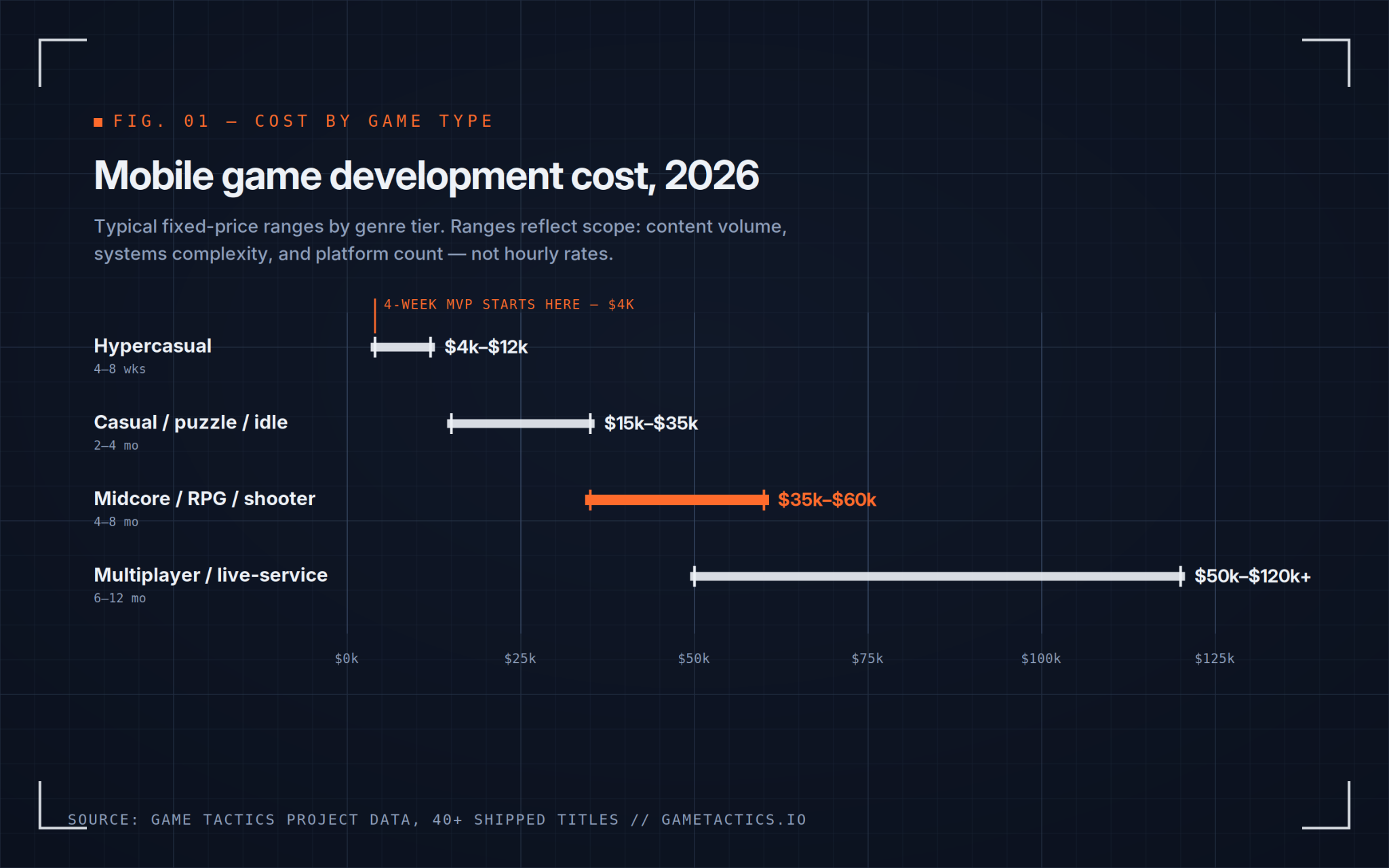
Mobile game development cost by genre
Genre is the single biggest predictor of cost, because it determines content volume, systems complexity, and how much polish players expect.
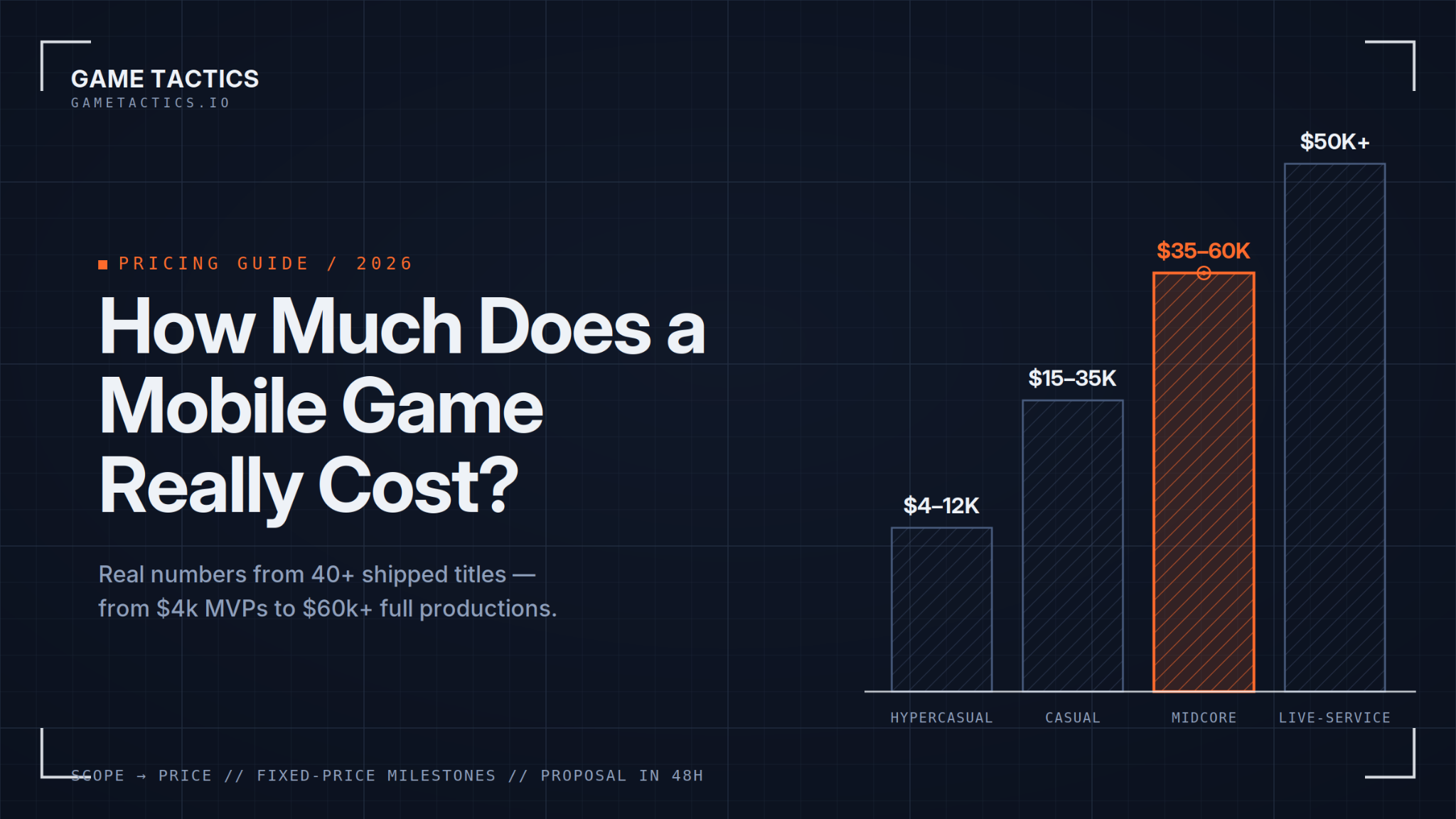
| Game type | Typical cost | Timeline | Examples |
|---|---|---|---|
| Hypercasual (single mechanic) | $4,000-$12,000 | 4-8 weeks | Runner, merge, tap-timing games |
| Casual (match-3, puzzle, idle) | $15,000-$35,000 | 2-4 months | Match-3 with meta progression, idle RPG |
| Midcore (RPG, strategy, shooter) | $35,000-$60,000+ | 4-8 months | Auto-battlers, base builders, FPS |
| Multiplayer / live-service | $50,000-$120,000+ | 6-12 months | Real-time PvP, synchronous co-op |
A few notes on why these ranges are so wide:
Hypercasual is cheap because the game is one mechanic. The real cost in hypercasual isn't development, it's the iteration loop. Publishers expect CPI-testable builds fast, so speed matters more than depth here.
Casual games look simple but carry heavy content costs. A match-3 game needs hundreds of levels, a tuned difficulty curve, and a meta layer (collections, decorations, events) that keeps players returning. Level design and economy tuning often cost more than the core mechanic.
Midcore adds systems on top of systems: character progression, loot, PvP balancing, server-authoritative logic. Every system multiplies QA time.
Multiplayer is its own tier because networking touches everything. Real-time sync (Photon, Netcode for GameObjects), matchmaking, anti-cheat, and backend infrastructure add both build cost and ongoing server cost.
The five factors that drive 80% of your quote
1. Art style and content volume. Art is usually 30-45% of a mobile game budget. Stylized low-poly 3D or clean 2D vector art costs a fraction of high-fidelity 3D with custom animations. The bigger multiplier is volume: 5 characters vs 50, 10 levels vs 400.
2. Platform count. iOS + Android together adds roughly 10-15% over a single platform (store compliance, device testing, platform-specific bugs). Adding WebGL or Steam later is a porting project of its own, plan for it early if cross-platform is the goal.
3. Backend and multiplayer. A fully offline game needs no servers. Add cloud save, leaderboards, or IAP validation and you're integrating Firebase or PlayFab. Add real-time multiplayer and you've roughly doubled the engineering complexity of the project.
4. LiveOps readiness. If the plan is to run events, seasonal content, and remote-configured offers after launch, that infrastructure has to be built in, remote config, A/B testing hooks, analytics events (GameAnalytics, AppsFlyer), and a content pipeline your team can operate without an engineer.
5. Who you hire. Regional rates vary enormously: US/UK agencies commonly bill $100-$200/hr, Eastern Europe $40-$80/hr, and senior South Asian studios $25-$50/hr. Rate alone is misleading, though, what matters is the cost to ship, which depends on how many hours a team burns and how much rework you eat. A studio with shipped titles in your genre is nearly always cheaper in total than a cheaper hourly rate learning on your budget.
MVP first, or full production?
This is the highest-leverage budgeting decision you'll make.
Going straight to full production makes sense when the design is proven, you're building a known genre with a clear reference, or you have publisher requirements in hand.
For everything else, build an MVP first. Our 4-Week MVP Sprint (from $4,000) takes a concept to a playable, testable build in 28 days: week one scoping, week two core build, week three polish, week four ship. You end up with something you can put in front of players, publishers, or investors, before committing to a $40k production budget.
The math is straightforward: spending $4k to learn your core loop doesn't retain players is vastly cheaper than learning it after full production.
Hidden costs founders forget
- Store assets and ASO, icons, screenshots, preview videos, metadata, and submission handling. Budget $500-$2,000 if it's not included in your dev contract (it's included in ours).
- QA on real devices, emulator testing misses real-world crashes. Device-farm testing across low-end Android hardware is where most launch bugs are caught.
- Third-party SDK integration, ads mediation, attribution (AppsFlyer), analytics. Each SDK is "just a plugin" until it conflicts with another one.
- Post-launch support, OS updates, store policy changes, and crash fixes don't stop at launch. Budget 15-20% of build cost per year for maintenance, more if you're running LiveOps.
- Apple and Google fees, $99/year (Apple), $25 one-time (Google), plus the 15-30% platform revenue cut on IAP.
How to get an accurate quote (and spot a bad one)
A serious studio should be able to give you a fixed price with milestones after seeing a one-pager or a deck, not an open-ended hourly estimate that "depends." When we scope a project, you get a proposal within 48 hours covering scope, milestones, timeline, and a fixed price, and once it's agreed, that's the number.
Red flags to watch for: quotes without a milestone breakdown, no mention of who owns the IP (you should, 100%, with repos in your name), and studios that can't show shipped titles in your genre on the actual stores.
Have a concept and want a real number instead of a range? Send us a brief, we'll return a scoped proposal with a fixed price within 48 hours.
GET A FIXED-PRICE QUOTE→FAQ
How much does it cost to make a simple mobile game? A single-mechanic hypercasual or casual game starts around $4,000-$12,000 as a polished MVP. That includes design, development, basic art, and store submission.
How long does mobile game development take? An MVP takes about 4 weeks. Casual games typically take 2-4 months; midcore titles 4-8 months. Timeline scales with content volume more than with mechanic complexity.
Is it cheaper to hire freelancers or a studio? Individual freelancers have lower rates but you become the producer, coordinating design, art, code, and QA yourself. A full-cycle studio costs more per hour but ships under one contract with one point of accountability. For anything beyond a prototype, the studio route usually costs less in total.
Do I own the game if I outsource development? With any reputable studio, yes, insist on full IP assignment and repositories in your name from day one. That's our standard contract term, not an upsell.
Can I start with just an idea? Yes. Many of our projects start as a one-page concept. Scoping the idea into a buildable MVP spec is part of week one.